


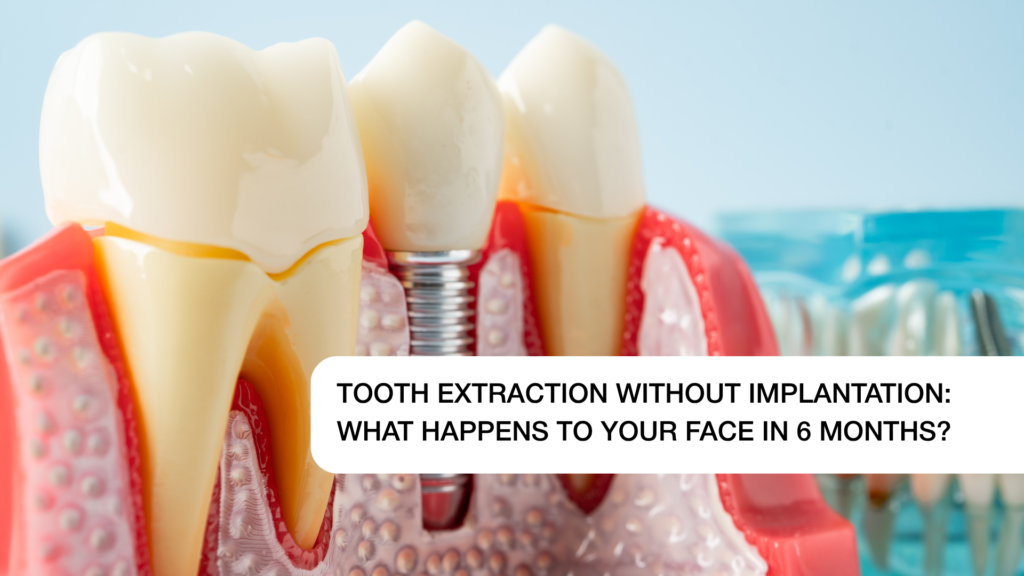
When you lose a tooth, it’s natural to focus on the gap in your smile. However, the most significant changes happen where you can’t see them—inside your jawbone.
At Cosmetic Dentistry Center in Brooklyn, we often see patients who wait years to replace a missing tooth. Unfortunately, your jawbone is like a muscle: if you don’t use it, you lose it. Here is the timeline of what happens to your face when a tooth is not replaced by an implant.
1. The “Invisible” Bone Loss Starts Immediately
Within the first six months after an extraction, the jawbone in that area can lose up to 25% of its volume. Without the tooth root to stimulate the bone through chewing, the body begins to resorb (absorb) the bone tissue. This process, known as bone loss after tooth loss, is irreversible without surgical intervention.
2. The “Domino Effect” of Shifting Teeth
Your teeth rely on each other for stability. When a gap is left open, the neighboring teeth begin to tilt and “drift” into the empty space. This ruins your bite alignment and can lead to:
-
Difficulty chewing.
-
New gaps forming between other teeth.
-
Increased risk of gum disease and further tooth loss.
3. Premature Aging and “Facial Collapse”
This is the most distressing change. As the jawbone shrinks, it no longer provides the necessary support for your facial muscles and skin. After 6 to 12 months, you may notice:
-
Sunken Cheeks: Your face begins to look hollow.
-
Shifting Jawline: The distance between your nose and chin shortens.
-
Increased Wrinkles: The skin around your mouth sags, leading to premature fine lines.
The Solution: Dental Implants as a “Fountain of Youth”
Unlike bridges or dentures, dental implants in Brooklyn act as artificial tooth roots. They fuse with your bone (osseointegration), providing the vital stimulation needed to keep your jawbone strong and your facial structure youthful.
Don’t Wait Until It’s Too Late
The longer you wait, the more bone you lose, which may require complex “bone grafting” before an implant can even be placed. Replacing a tooth now is much simpler and more affordable than fixing a collapsed facial structure later.