


Decades ago, if you lost a tooth, a dental bridge was the gold standard. It was reliable, relatively fast, and looked decent. However, as technology has evolved, so has our understanding of long-term oral health.
At Cosmetic Dentistry Center in Brooklyn, we have seen a significant shift in patient preferences. Today, we almost always recommend implants over bridges. Here is the medical and aesthetic reasoning behind this transition.
1. The “Healthy Neighbor” Sacrifice
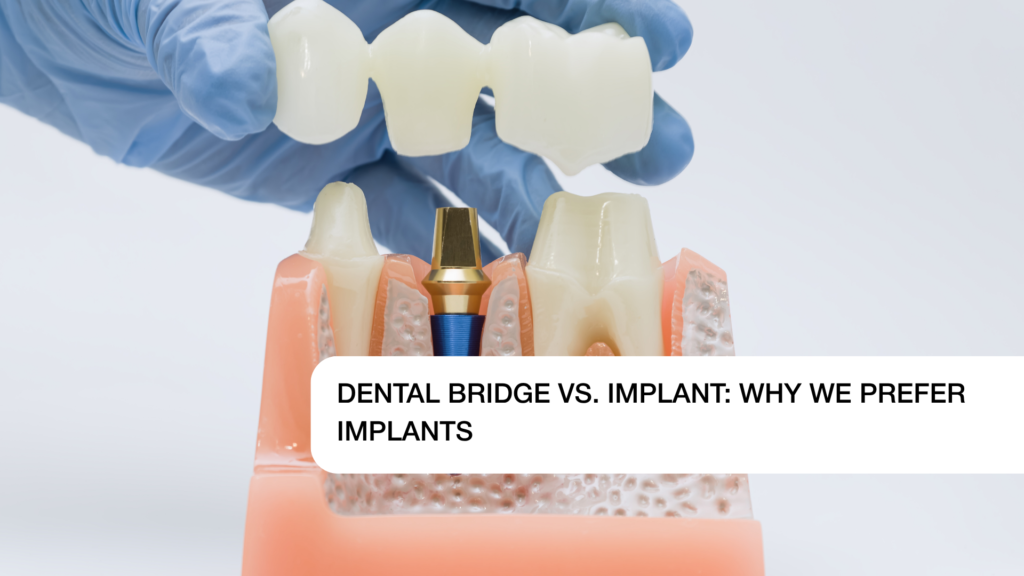
The biggest drawback of a dental bridge is that it requires “prepping” (shaving down) the two healthy teeth adjacent to the gap to act as anchors.
-
The Problem: You are essentially compromising two healthy teeth to fix one missing one. If one of those anchor teeth develops a cavity or gum disease, the entire bridge fails.
-
The Implant Advantage: An implant is a standalone solution. It doesn’t rely on or touch your other teeth, preserving your natural tooth structure.
2. The Battle Against Bone Loss
When a tooth is removed, the jawbone beneath it no longer receives stimulation from chewing.
-
The Problem: A bridge sits on top of the gums. It doesn’t replace the tooth root, which means the bone underneath will eventually shrink (resorb). This can lead to a visible gap under the bridge and changes in your facial structure.
-
The Evidence: According to the American Academy of Implant Dentistry, implants are the only restoration that preserves and stimulates natural bone growth.
3. Longevity and “Real” Cost
Many patients in NYC initially lean toward bridges because the upfront cost of a dental bridge vs. implant is lower.
-
The Reality: A dental bridge typically lasts 10–15 years before it needs replacement. An implant, when properly maintained, is designed to last a lifetime.
-
The Math: When you factor in the cost of replacing a bridge 2 or 3 times over your life, the implant becomes the much more affordable investment.
4. Hygiene and Maintenance
Cleaning under a bridge requires special threaders and extra effort. If hygiene slips, bacteria thrive under the false tooth. An implant, however, functions exactly like a natural tooth—you brush and floss it just like the rest of your smile.
What the Experts Say
The medical community’s preference for implants is backed by extensive research. Organizations like the American Association of Oral and Maxillofacial Surgeons emphasize that implants offer a nearly 98% success rate and superior long-term health outcomes compared to tooth-supported bridges.
Furthermore, studies indexed by the National Institutes of Health (NIH) highlight that dental implants significantly improve the quality of life and chewing efficiency for patients compared to traditional prosthetics.
Is a Bridge Ever the Right Choice?
While we prefer implants, bridges are still a viable option if a patient has significant bone loss that prevents implantation or has health conditions that make surgery difficult. During your consultation in our Brooklyn office, we use 3D imaging to determine which path is safest for you.